

2026 · Review Series: Food Security
REVIEW ARTICLE | Open Access · CC BY 4.0
Dr. Walid Nosir1,2
1 Zagazig University, Zagazig, Egypt
2 Future Association for Science and Education (FASE), Indianapolis, IN 46240, USA
Correspondence: w.nosir@gmail.com
DOI: https://doi.org/10.37229/fas.2026.005
Abstract
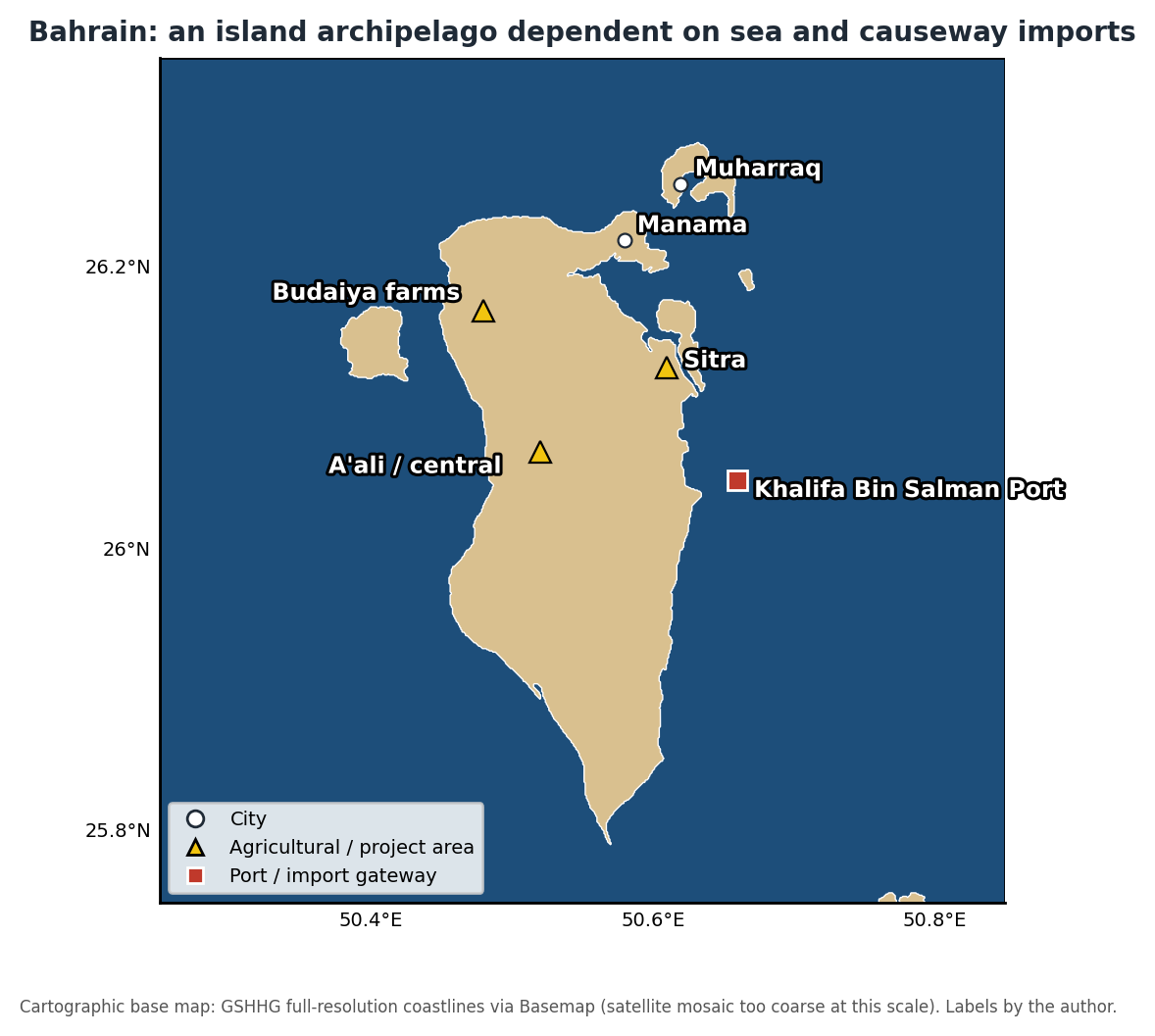
Bahrain is the smallest Gulf Cooperation Council state, an archipelago of about 780 km² whose agriculture once rested on abundant freshwater springs and extensive date-palm gardens. Over the past fifty years its population grew from roughly a quarter of a million to about 1.6 million. Urban expansion, coastal reclamation and groundwater depletion meanwhile shrank the agricultural area and degraded the shallow aquifer that once fed the springs. Bahrain now imports about 90% of its food. Imports arrive mainly through Khalifa Bin Salman Port and across the King Fahd Causeway to Saudi Arabia, which opened in 1986. Despite this dependence, Bahrain's household food security is high. It ranked 38th of 113 countries in the 2022 Global Food Security Index with a score of 70.3, up from 50th in 2019. This rests on high incomes, subsidies on staples (partly converted into direct cash support from 2015), strategic stockholding and state-supported production of perishable goods. National targets aim to raise vegetable self-sufficiency from about 10% to 20%, fish from about 50% to 62%, and egg output from about 90 million to 120 million per year. Domestic production of dates and fresh poultry is supported through public companies and the Ghitha holding company. This review traces Bahrain's food-security evolution, assesses the land, water and marine constraints, and examines exposure to logistic chokepoints highlighted by the 2026 Hormuz disruption. The main lesson is that, for a small island economy, food security depends less on production volume than on robust logistics, reserves, social protection and protecting the marine and groundwater commons.
Cite as: Nosir, W. (2026). Food Security in the Kingdom of Bahrain, 1975–2025: An Island Food System Between Import Dependence, Land Reclamation and Targeted Self-Sufficiency. The Future of Applied Science, Article 005. https://doi.org/10.37229/fas.2026.005
Keywords : Bahrain, food security, small island state, import dependence, date palms, fisheries, poultry, land reclamation, King Fahd Causeway, Strait of Hormuz,
Received:11/7/2026 12:00:00 AM; Accepted: 11/7/2026 12:00:00 AM