

2026 · Review Series: Food Security
REVIEW ARTICLE | Open Access · CC BY 4.0
Dr. Walid Nosir1,2
1 Zagazig University, Zagazig, Egypt
2 Future Association for Science and Education (FASE), Indianapolis, IN 46240, USA
Correspondence: w.nosir@gmail.com
DOI: https://doi.org/10.37229/fas.2026.003
Abstract
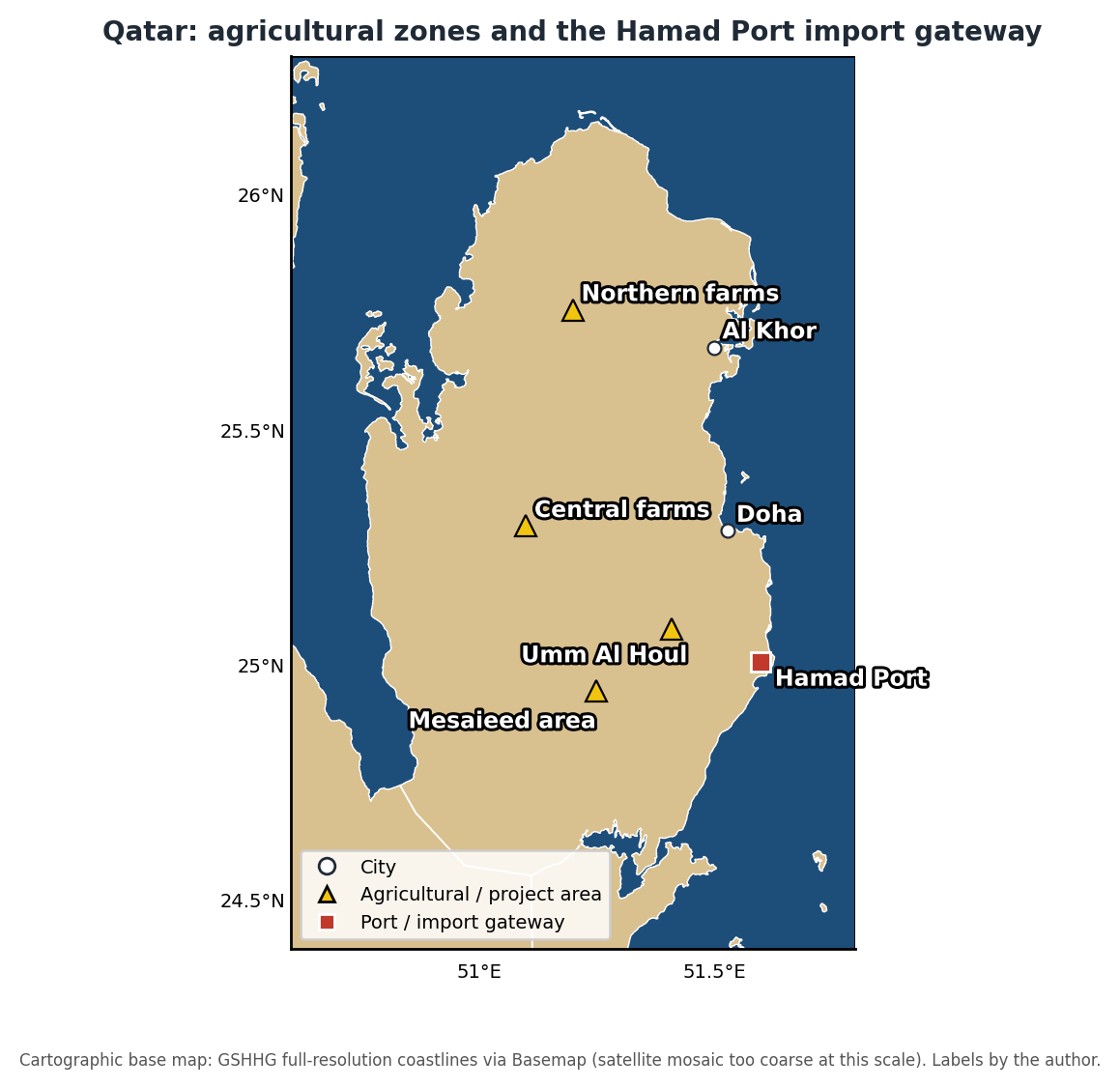
Qatar combines one of the world's highest per-capita incomes with one of its least favourable environments for agriculture. It has no permanent rivers, minimal rainfall, saline soils and a single land border. For most of the period since 1975 its food security rested on wealth and imports, more than 90% of them routed through neighbouring Gulf states. Population growth from under 200,000 in the mid-1970s to around three million by the 2020s multiplied demand without changing that model. Two shocks reshaped policy. The 2007–2008 global food price crisis led to the creation of the Qatar National Food Security Programme in 2008. The diplomatic and trade blockade imposed by Saudi Arabia, the United Arab Emirates, Bahrain and Egypt in June 2017 then abruptly closed the land border and regional transhipment routes. Qatar responded by opening direct shipping lines through the new Hamad Port, airlifting dairy cattle, and adopting a National Food Security Strategy for 2018–2023, followed by a 2030 strategy. Self-sufficiency rose from about 28% to above 100% for fresh dairy, reached about 127% for fresh poultry, and rose from about 20% to 46% for vegetables. Red meat remained at about 18%. Qatar's Global Food Security Index rank improved from 29th in 2017 to 13th in 2019 before methodology changes placed it 30th in 2022. This review analyses the strategy's components, costs and limits, including heavy dependence on imported feed and energy-intensive desalination, and the renewed exposure revealed by the 2026 Hormuz shipping disruption.
Cite as: Nosir, W. (2026). Food Security in the State of Qatar, 1975–2025: From Near-Total Import Dependence to Blockade-Driven Self-Reliance. The Future of Applied Science, Article 003. https://doi.org/10.37229/fas.2026.003
Keywords : Qatar, food security, 2017 blockade, self-sufficiency, National Food Security Strategy, dairy, protected agriculture, Hamad Port, strategic reserves, Strait of Hormuz,
Received:11/7/2026 12:00:00 AM; Accepted: 11/7/2026 12:00:00 AM