

2026 · Review Series: Food Security
REVIEW ARTICLE | Open Access · CC BY 4.0
Dr. Walid Nosir1,2
1 Zagazig University, Zagazig, Egypt
2 Future Association for Science and Education (FASE), Indianapolis, IN 46240, USA
Correspondence: w.nosir@gmail.com
DOI: https://doi.org/10.37229/fas.2026.004
Abstract
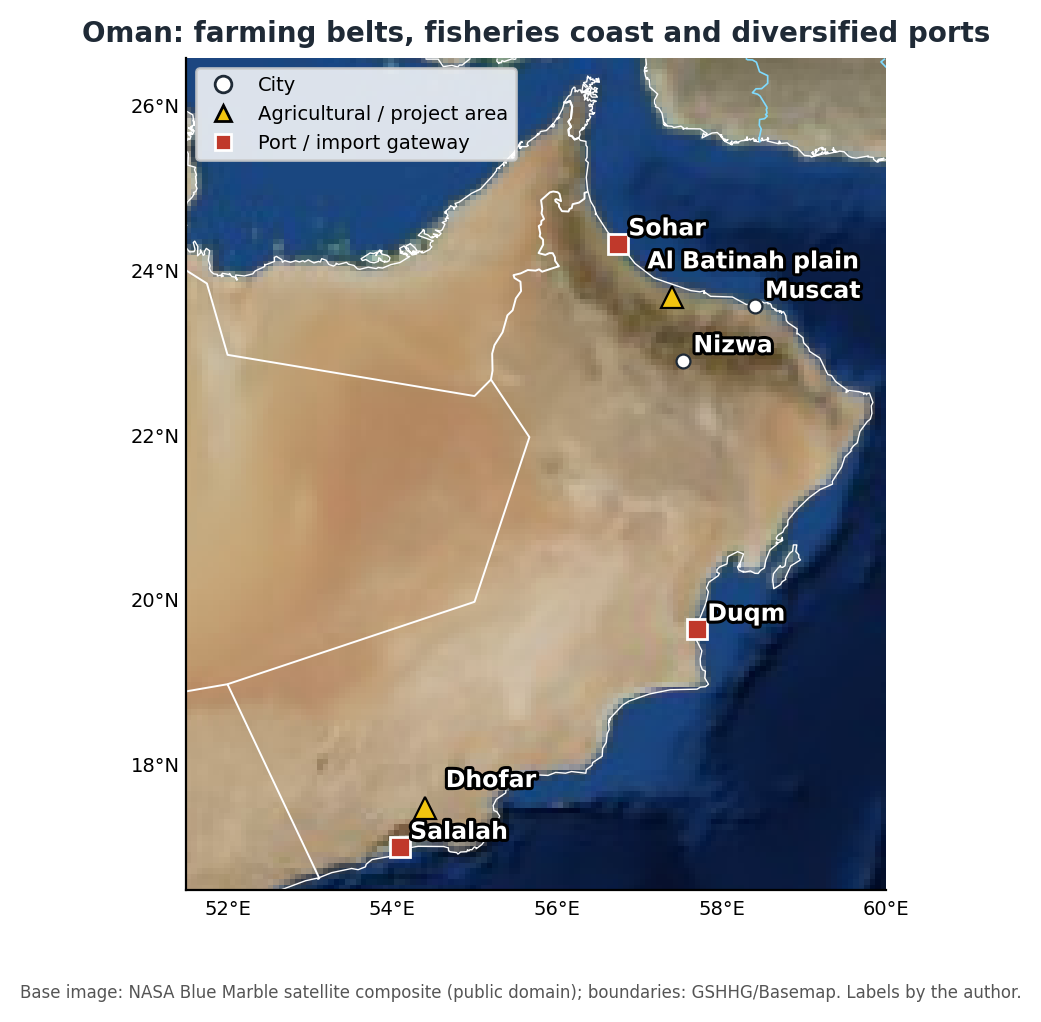
Oman differs from its Gulf neighbours in several respects relevant to food security: a long Arabian Sea coastline with productive fisheries, a monsoon-influenced southern region (Dhofar), an ancient irrigation tradition based on the falaj system, and major ports at Sohar, Duqm and Salalah that lie outside, or at the mouth of, the Strait of Hormuz. Since the start of the modern state in 1970, its population has grown from well under one million to over five million, and food demand has risen accordingly. This review traces Oman's food-security trajectory over five decades, drawing on National Centre for Statistics and Information data, ministry production statistics reported in the national press, the Global Food Security Index and the scholarly literature. Over the period, coastal agriculture on the Al Batinah plain suffered severe groundwater salinisation, which undermined date and lime cultivation. Since about 2010, however, deliberate investment in fisheries, aquaculture, dairy, poultry, eggs and protected vegetables has raised overall food self-sufficiency to about 65.8% in 2024, with sector ratios of 144.5% for fish, 87.3% for animal production, 66.4% for food and beverage industries and 49.4% for agricultural crop products. At commodity level, the latest reported self-sufficiency is about 146–162% for fish, 97–99% for dates, 92–97% for milk and 92–95% for eggs, while poultry stood at 55–60% and red meat at 46% in 2023. Oman scored 71.2 in the 2022 GFSI (35th of 113), and its gain of 13.8 points since 2012 was the largest improvement of any country. The review concludes that Oman's combination of marine resources, targeted investment and port diversification offers a model for arid states, while water quality, climate risk and feed dependence remain the principal constraints.
Cite as: Nosir, W. (2026). Food Security in the Sultanate of Oman, 1975–2025: Fisheries, Falaj Agriculture and the Rise of Diversified Self-Sufficiency. The Future of Applied Science, Article 004. https://doi.org/10.37229/fas.2026.004
Keywords : Oman, food security, self-sufficiency, fisheries, dates, falaj irrigation, Al Batinah salinisation, Vision 2040, Global Food Security Index, ports,
Received:11/7/2026 12:00:00 AM; Accepted: 11/7/2026 12:00:00 AM