

2026 · Review Series: Food Security
REVIEW ARTICLE | Open Access · CC BY 4.0
Dr. Walid Nosir1,2
1 Zagazig University, Zagazig, Egypt
2 Future Association for Science and Education (FASE), Indianapolis, IN 46240, USA
Correspondence: w.nosir@gmail.com
DOI: https://doi.org/10.37229/fas.2026.002
Abstract
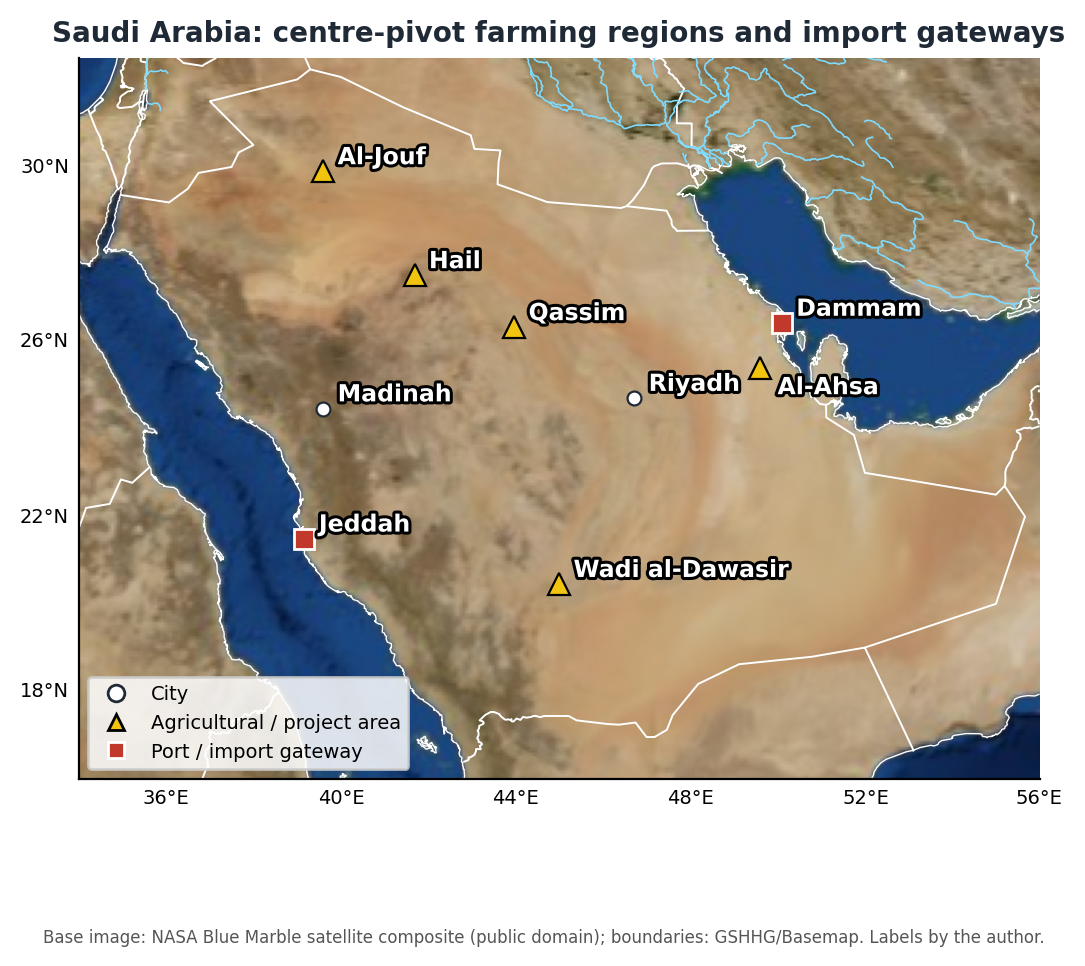
Saudi Arabia offers one of the most dramatic natural experiments in modern food policy. After the 1973 oil embargo and fears of a retaliatory food embargo, the Kingdom used its oil wealth to subsidise desert wheat on a vast scale. Production rose from about 148,000 tonnes in 1981 to 4.1 million tonnes (Mt) in 1992, turning the country into a net wheat exporter from the mid-1980s. Irrigated area expanded from about 373,000 hectares in 1973 to 1.57 million hectares in 1992, and the programme absorbed subsidies estimated at more than US$5 billion per year in 1984–2000. The price was paid in non-renewable groundwater: agriculture came to account for up to 80% or more of national water use, drawing down fossil aquifers that recharge only negligibly. Policy reversed in stages, first through procurement cuts in the 1990s and then through a 2008 decision to phase out state wheat purchases by 2016. As a result wheat imports rose from about 0.3 Mt in 2008 to 3 Mt in 2014 and 4.8 Mt in 2022, when they covered about three-quarters of demand. Food security strategy shifted towards strategic storage, diversified imports, overseas agricultural investment through the Saudi Agricultural and Livestock Investment Company (SALIC), and high-value, water-efficient domestic production in poultry, dairy, dates and protected horticulture. This review traces those phases, evaluates their costs and outcomes, and examines new risks, including the 2026 disruption of shipping through the Strait of Hormuz. Saudi Arabia ranked 41st of 113 countries in the 2022 Global Food Security Index. The central lesson is that, in hyper-arid states, food security is best pursued as a portfolio of trade, storage, investment and targeted production rather than as cereal self-sufficiency.
Cite as: Nosir, W. (2026). From Desert Wheat to Global Sourcing: Fifty Years of Food Security Policy in the Kingdom of Saudi Arabia (1975–2025). The Future of Applied Science, Article 002. https://doi.org/10.37229/fas.2026.002
Keywords : Saudi Arabia, food security, wheat self-sufficiency, groundwater depletion, agricultural subsidies, overseas agricultural investment, SALIC, Vision 2030, Strait of Hormuz, Gulf Cooperation Council,
Received:11/7/2026 12:00:00 AM; Accepted: 11/7/2026 12:00:00 AM