

REVIEW ARTICLE | Open Access · CC BY 4.0
Walid Nosir1,2,*
1 Zagazig University, Zagazig, Egypt
2 Future Association for Science and Education (FASE), Indianapolis, IN 46240, USA
* Correspondence: w.nosir@gmail.com
DOI: https://doi.org/10.37229/fee.v1i1.006
Abstract
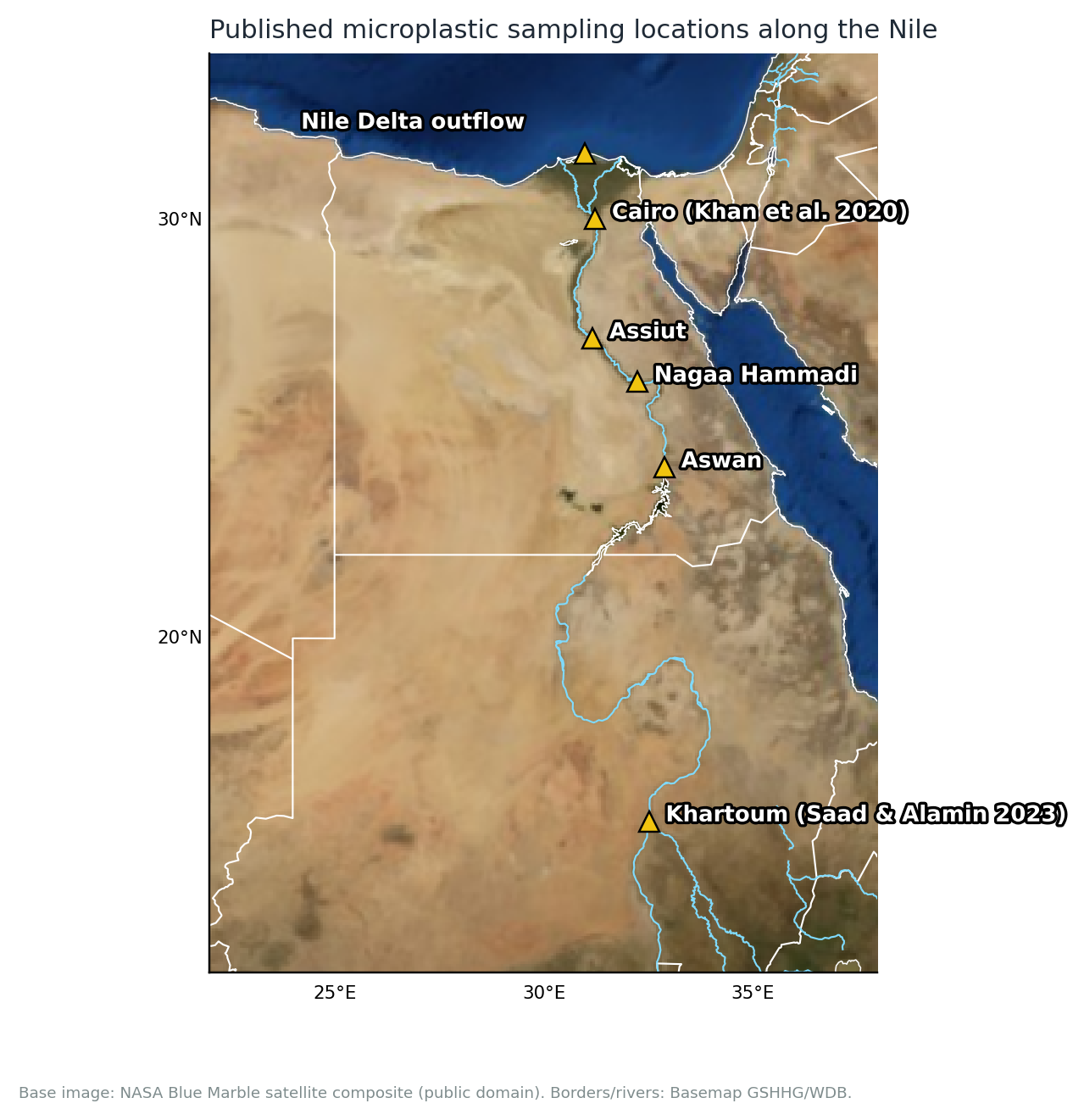
Plastic pollution has become one of the most pervasive forms of environmental contamination, and the semi-enclosed Mediterranean Sea is among the most plastic-polluted water bodies in the world. Rivers are major conduits of land-based plastic to the sea, yet the Nile, the longest river on Earth and the lifeline of Egypt and Sudan, was not studied for microplastics until 2020. This review synthesises global and regional evidence on the sources, transport, occurrence and effects of plastics and microplastics (particles smaller than 5 mm) in the Nile basin and the eastern Mediterranean. Egypt was estimated in 2010 to be among the ten countries generating the largest mass of mismanaged plastic waste in coastal populations. The first studies in the Nile found microplastics in the digestive tracts of more than 75% of fish sampled in Cairo, and in every fish examined in a later study at Khartoum, with fibres and fragments dominating. Microplastics have also been reported in water, sediments and invertebrates of the Upper Egyptian Nile and in coastal waters and beaches of the Egyptian Mediterranean. The ecological consequences include physical damage, reduced feeding and transfer of associated chemical additives, while human exposure occurs through fish, drinking water, salt and air; health effects remain uncertain but are a growing concern. The review identifies the weaknesses of current evidence, particularly methodological heterogeneity and small sample sizes, and proposes priorities for waste management, monitoring and regulation in the region.
Keywords: microplastics; plastic waste; Nile River; Mediterranean Sea; freshwater fish; Nile tilapia; mismanaged waste; human exposure; monitoring
Cite as: Nosir, W. (2026). Plastic and Microplastic Pollution in the Nile River and the Eastern Mediterranean: Sources, Occurrence, Ecological and Human-Health Risks. The Future of Earth & Environment, 1(1), 006. https://doi.org/10.37229/fee.v1i1.006
The Future of Earth & Environment — Volume 1, Issue 1 (2026)
Keywords : microplastics, plastic waste, Nile River, Mediterranean Sea, freshwater fish, Nile tilapia, mismanaged waste, human exposure, monitoring,
Received:11/7/2026 12:00:00 AM; Accepted: 11/7/2026 12:00:00 AM