

REVIEW ARTICLE | Open Access · CC BY 4.0
Walid Nosir1,2,*
1 Zagazig University, Zagazig, Egypt
2 Future Association for Science and Education (FASE), Indianapolis, IN 46240, USA
* Correspondence: w.nosir@gmail.com
DOI: https://doi.org/10.37229/fee.v1i1.008
Abstract
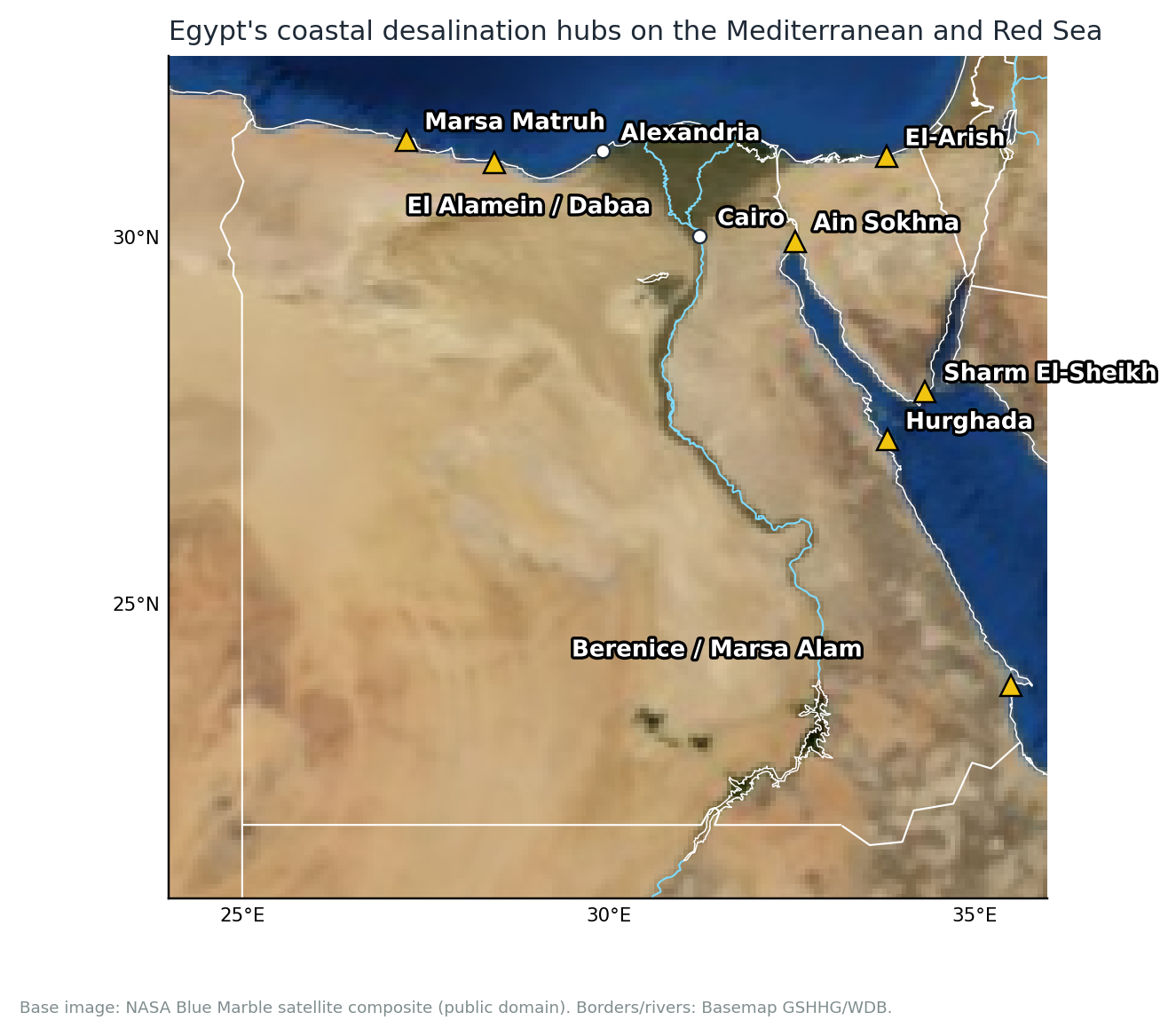
Desalination has become indispensable to water security in the Middle East and North Africa (MENA), which produces almost half of the world's desalinated water. Egypt, facing a widening gap between Nile supply and demand, plans to expand seawater desalination from about 1.2–1.4 million m³ per day today to several million m³ per day within a decade. This review synthesises evidence on the environmental impacts of desalination, with emphasis on brine discharge, chemical additives, intake effects and energy use, and on management options relevant to Egypt's Mediterranean and Red Sea coasts. Globally, about 15,900 plants produce some 95 million m³ per day of fresh water and about 142 million m³ per day of brine, of which about 70% is produced in MENA. Brine, typically with roughly twice the salinity of seawater and containing antiscalants, coagulants and cleaning chemicals, can form dense plumes that affect seagrasses, corals and benthic communities near outfalls, particularly in poorly flushed embayments. Intakes cause impingement and entrainment of marine organisms, and energy use, still dominated by fossil fuels, generates substantial greenhouse-gas emissions. The review shows that most impacts can be reduced through careful site selection, subsurface intakes, diffuser outfalls, environmental monitoring, renewable energy and emerging brine-valorisation technologies, and proposes guidelines for Egypt's expansion, particularly to protect the Red Sea's coral reefs.
Keywords: desalination; brine; reverse osmosis; marine environment; Red Sea; Mediterranean; Egypt; energy; renewable desalination; brine management
Cite as: Nosir, W. (2026). Seawater Desalination in the Middle East and North Africa: Environmental Impacts of Brine Discharge, Energy Use and Pathways to Sustainable Expansion in Egypt. The Future of Earth & Environment, 1(1), 008. https://doi.org/10.37229/fee.v1i1.008
The Future of Earth & Environment — Volume 1, Issue 1 (2026)
Keywords : desalination, brine, reverse osmosis, marine environment, Red Sea, Mediterranean, Egypt, energy, renewable desalination, brine management,
Received:11/7/2026 12:00:00 AM; Accepted: 11/7/2026 12:00:00 AM