

REVIEW ARTICLE | Open Access · CC BY 4.0
Walid Nosir1,2,*
1 Zagazig University, Zagazig, Egypt
2 Future Association for Science and Education (FASE), Indianapolis, IN 46240, USA
* Correspondence: w.nosir@gmail.com
DOI: https://doi.org/10.37229/fee.v1i1.001
Abstract
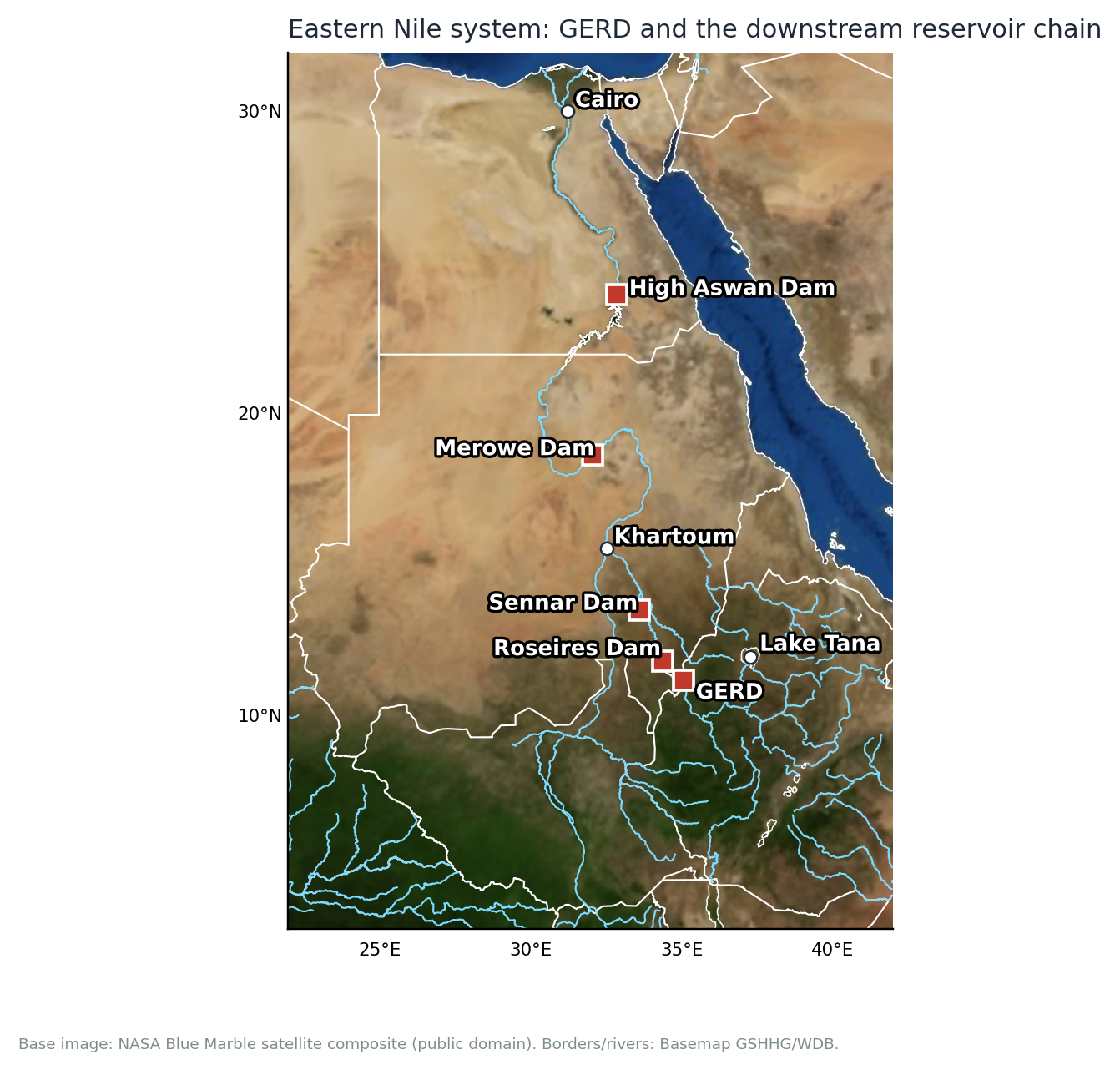
The Grand Ethiopian Renaissance Dam (GERD), inaugurated on 9 September 2025, is the largest hydropower project in Africa, with a design storage of 74 billion cubic metres (bcm) on the Blue Nile, which supplies the majority of the Nile's annual flow at Aswan. Its five-stage impoundment (2020–2024) and first year of full operation were completed without a binding agreement among Ethiopia, Sudan and Egypt. This review synthesises peer-reviewed modelling studies, satellite observations and official records to assess the dam's downstream risks. The evidence shows that the principal hazards for Egypt are not average-year shortfalls but the loss of control over the timing and volume of inflows during multi-year droughts, when the High Aswan Dam reservoir could be drawn below its minimum operating levels; published estimates of filling-period deficits range from negligible to more than 30 bcm per year depending on hydrology, filling rules and assumptions about seepage and evaporation. For Sudan, the dam offers flood attenuation and more regular flows but also brings dam-safety exposure, the loss of flood-recession agriculture, reduced sediment and nutrient delivery, and operational dependence on unannounced upstream releases, illustrated by the disputed September–October 2025 flood. Additional concerns include reservoir evaporation and seepage, sediment trapping, water-quality changes and reduced groundwater recharge along the Nile valley. The review concludes that most of these harms are manageable but only through a legally binding, data-sharing and drought-management agreement, and identifies research priorities for monitoring and coordinated operation.
Keywords: Grand Ethiopian Renaissance Dam; Blue Nile; High Aswan Dam; Egypt; Sudan; water security; transboundary rivers; reservoir filling; drought; Nile flood
Cite as: Nosir, W. (2026). The Grand Ethiopian Renaissance Dam and Its Downstream Consequences for Egypt and Sudan: A Review of Hydrological, Agricultural, Environmental and Governance Risks. The Future of Earth & Environment, 1(1), 001. https://doi.org/10.37229/fee.v1i1.001
The Future of Earth & Environment — Volume 1, Issue 1 (2026)
Keywords : Grand Ethiopian Renaissance Dam, Blue Nile, High Aswan Dam, Egypt, Sudan, water security, transboundary rivers, reservoir filling, drought, Nile flood,
Received:11/7/2026 12:00:00 AM; Accepted: 11/7/2026 12:00:00 AM